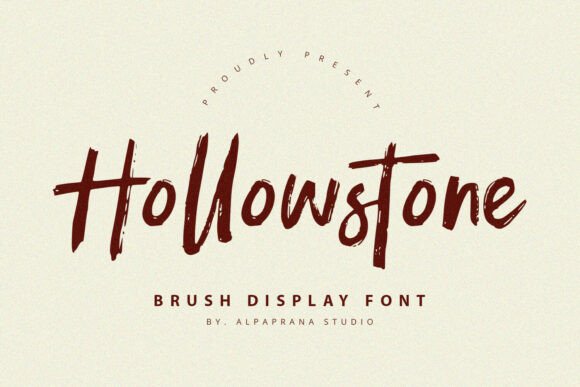
Hollowstone: A Handcrafted Brush Display Font for Makers
As someone who hand-labels small-batch candles, designs printable wedding suites, and cuts vinyl decals for local boutiques, I know how much a font can shape the soul of a product. Hollowstone isn’t just another display font—it’s a warm, organic brush typeface that breathes life into physical goods. Its uneven stroke weight, subtle texture, and natural flow make it feel like it was painted by hand—not generated by an algorithm. That authenticity shows up on every sticker, tag, and sign you create.
I reach for Hollowstone when I need something that balances charm with clarity—especially for customer-facing items. It’s not meant for paragraphs or fine print, but it shines in short, high-impact phrases: “Small Batch,” “Hand-Poured,” “Est. 2022,” or “Welcome Home.” Because it’s a display font, its strength lies in titles, logos, and focal points—not body text. That makes it ideal for packaging headers, greeting card covers, and SVG-based wall art where one word carries emotional weight.
For crafters using Cricut Design Space or Silhouette Studio, Hollowstone cuts cleanly at sizes above 24pt. I’ve tested it on matte vinyl stickers as small as 1.5 inches wide—the letterforms hold their shape without losing character. On kraft paper labels? It looks like it belongs there. On white ceramic mugs? It adds quiet confidence without shouting. Just avoid scaling it below 16pt for printed tags or tiny jar labels—some of the finer brush details soften or vanish at ultra-small sizes.
Think about what you make daily: soy candle labels with minimalist botanical illustrations, farmhouse-style wooden signs for baby nurseries, holiday gift tags with gold foil accents, or boutique clothing tags stitched onto linen drawstring bags. Hollowstone fits all of them—not because it’s neutral, but because it’s *intentionally expressive*. It says “carefully made” before the customer even reads the words.
It also works beautifully across seasonal collections. I used Hollowstone last spring for a set of printable Easter planner pages—“Hop Into Joy” felt playful but grounded. In fall, it anchored a line of apple cider soap labels (“Crisp & Kind”) beside a clean sans serif for ingredients. For winter holiday cards, pairing Hollowstone with a delicate script font (like a light flourished script) created elegant contrast—bold yet tender.
Font pairing is where Hollowstone truly earns its place in your design toolkit. Because it’s a brush display font with strong personality, it pairs best with quieter companions: a crisp geometric sans serif (like Montserrat or Poppins) for supporting text, or a gentle serif (like Lora or Cormorant Garamond) for invitations and stationery. Avoid pairing it with other heavy display fonts—that’s visual noise, not harmony. And if you’re designing digital templates for Etsy, remember: Hollowstone should headline; your secondary font handles the fine print, sizing guides, and usage notes.
Inside the Hollowstone package, you’ll find OpenType features that matter to makers: standard ligatures for smoother joins (like “fi” or “fl”), stylistic alternates for customizing letters like “a” or “g,” and multilingual support covering Western European languages—enough for most US, Canadian, UK, and EU-based sellers. File formats include OTF and TTF, so it installs smoothly whether you're working in Canva, Affinity Designer, or Adobe Illustrator. No web font files are included, and that’s fine—this is a font built for physical output, not website headlines.
Practical tip: Always test Hollowstone in your final production workflow. If you’re exporting SVGs for cutting machines, open the file in your cutter software first and check spacing—some brush fonts need slight manual kerning adjustments for tight phrases like “Made With Love.” Likewise, if you’re creating printable PDFs for customers, embed the font or outline the text to prevent substitution on their end.
One thing I never skip: checking the commercial license. Hollowstone is licensed for use in physical products you sell—candle labels, t-shirt prints, tote bag embroidery files, and sticker sheets are all covered. It’s also cleared for digital downloads like Canva templates, Procreate brushes with text elements, and SVG bundles for crafters. Just remember: you can’t resell Hollowstone itself, and you shouldn’t offer it as a standalone font download. But using it to build your brand? Absolutely—and it elevates everything from your Instagram story banners to your shop banner image.
I’ve seen Hollowstone transform simple product photography. A plain kraft box with a Hollowstone-printed “Thank You” tag feels more thoughtful than the same phrase in Helvetica. A chalkboard-style welcome sign for a bridal shower becomes instantly warmer with Hollowstone’s soft edges. Even my own shop logo evolved once I swapped out a generic bold sans for Hollowstone—it didn’t just look prettier; it looked *more like me*.
If you're choosing fonts for long-term brand consistency—whether you run a seasonal printable shop or a year-round handmade apothecary—Hollowstone delivers both flexibility and fidelity. It’s not trendy in a fleeting way. It’s rooted in craft tradition but designed for modern tools. It respects the hand behind the work and honors the person holding the finished piece.
So next time you’re sketching a new label layout, drafting a wedding invitation suite, or building a digital planner bundle, give Hollowstone space to speak. Let it carry your voice—not loudly, but clearly, warmly, and unmistakably yours.